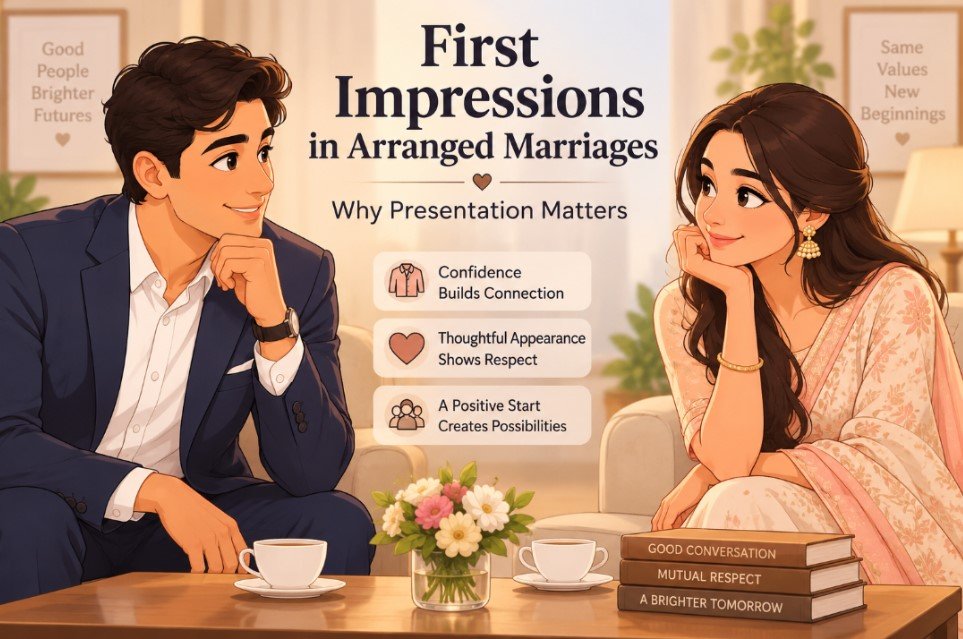
Two families receive biodatas on the same evening. The candidates are remarkably similar — same age, same qualifications, same kind of family background. One biodata arrives as a plain Word document, slightly misaligned, with a small passport photo in the corner. The other is clean, well-designed, with a warm natural photograph and information laid out so clearly it takes thirty seconds to read. The first family wonders if the second candidate is even available yet. This is how first impressions work in arranged marriages — and most people underestimate how much they matter.
The Arranged Marriage First Impression is Unlike Any Other
In most social contexts, first impressions are formed in person. You walk into a room, someone sees you, and within seconds they have formed an instinctive sense of who you are. In arranged marriages, that moment does not happen first. Before any phone call, before any meeting, before any in-person interaction, there is a document. The biodata arrives — on WhatsApp, over email, through a mutual relative — and a family sits down to read it. What they feel in those first thirty seconds shapes everything that follows.
This is a fundamentally different kind of first impression. It is mediated entirely through paper and design. You are not in the room. Your warmth, your laugh, your presence — none of it is accessible yet. What the family sees is a photograph, a layout, a choice of words. These become you, temporarily, until they decide to learn more. Which means the quality of how your biodata is presented is not a cosmetic concern — it is a substantive one.
Families receive many biodatas. In active matrimonial searches, a family might review five to fifteen biodatas in a single week. In that context, every biodata is competing — not necessarily for the best qualifications or the highest salary, but for attention, for interest, for the desire to know more. The ones that get a second look are almost always the ones that made a strong visual and emotional impression first.
What Families Actually Notice First
Before a family reads a single word of a biodata, they have already formed an impression. Understanding what they notice — and in what order — is the first step to getting it right.
The photograph
The photograph is always the first thing a family’s eyes go to. This is not shallow — it is human. We are wired to read faces before we read text. A warm, clear, recent photograph of a smiling person in natural light creates an immediate positive impression. A small, dark, blurry passport photo — or worse, a cropped group photo — creates the opposite.
Families are not just assessing appearance. They are reading expression, warmth, and confidence. A photograph where someone looks uncomfortable, overly posed, or simply unsmiling raises questions that have nothing to do with the person’s actual personality. The photograph sets an emotional tone before a word is read.
The overall layout and design
The second thing families notice is whether the biodata looks organized and considered, or rushed and generic. A well-designed biodata with clear sections, consistent formatting, and readable text signals that someone took this process seriously. A chaotic layout, mismatched fonts, crowded fields, and inconsistent spacing signals the opposite — even if the content itself is excellent.
This matters because families instinctively extend the presentation to the person. A carefully presented biodata suggests someone who pays attention to detail, who respects the process, who takes care with things that matter. It is an inference — not always accurate, but it is the inference families make.
How easy it is to read
A biodata that requires effort to read creates friction — and friction kills interest. If a family has to search for the candidate’s date of birth, or squint to read the occupation, or scroll past dense paragraphs to find the family details, they will simply move on to the next one. Information should be findable in seconds. Sections should be clearly labelled. The most important details — name, age, occupation, family — should be immediately visible without hunting.
The tone of the writing
Once a family begins reading, the writing itself creates an impression. Generic, copy-pasted phrases — “fun-loving, family-oriented, and hardworking” — read as careless. Specific, genuine descriptions — “works as a software engineer at a Pune-based startup, has been trekking in the Sahyadris for the past four years, close to both parents and an elder sister” — read as real. Families respond to the sense of a person behind the words. When the writing feels authentic, they want to know more. When it feels assembled from a template, they move on.
Why Presentation Signals Character
There is a deeper reason why presentation matters beyond aesthetics — and it is worth understanding clearly. The effort someone puts into their biodata is visible. Families can see it. A beautifully presented, thoughtfully written, carefully designed biodata communicates something specific: this person — or this family — takes this process seriously. They respect the families who will receive this document. They understand that first impressions matter and have invested accordingly.
The inverse is equally true. A poorly presented biodata — generic template, old photo, vague descriptions, careless formatting — communicates a lack of investment in the process. Families may wonder whether this reflects a broader attitude. These inferences are not fair — a badly designed biodata does not make someone a bad match — but they happen, and they happen fast.
There is also the question of family pride. In arranged marriages, the biodata represents not just the candidate but the entire family. A well-presented document reflects well on the family that prepared it. It signals that the family is organized, considerate, and attentive — qualities that prospective in-laws value enormously.
The Photo — Your Most Important First Impression Tool
No element of a marriage biodata has more immediate impact than the photograph. It deserves the most attention and the most care.
The best biodata photographs share a few consistent qualities. They are recent — taken within the last year, ideally the last six months. They are clear and well-lit, taken in natural daylight where possible. The background is simple — a plain wall, a neutral indoor setting, nothing distracting. The expression is natural and warm — a genuine smile, not a forced grin, not a blank stare. The attire is appropriate — formal or smart-casual depending on community, clean and well-fitted.
What to avoid is equally important. Sunglasses belong nowhere near a biodata photograph — they hide the face and create distance. Heavy filters that alter skin tone or smooth features create expectations that are not met in person, which starts a relationship with a subtle form of misrepresentation. Group photos that have been cropped are immediately obvious and create a poor impression. Old photographs — anything more than a year old — are a common mistake that families notice, particularly when they eventually meet someone in person.
The practical advice is simple: ask a family member or trusted friend to take ten to fifteen photographs of you in good natural light, in appropriate attire, in front of a plain background. Smile naturally. Take your time. Choose the one that looks most like you at your best — not the most glamorous, but the most genuine. That photograph will do more for your biodata than any other single element.
Design Matters More Than Most People Realize
Most people still create their marriage biodata in Microsoft Word, using a template that has been passed around the family for years. The result is almost always the same — a functional document that looks exactly like every other biodata the receiving family will see that week. It does the job, but it does nothing to distinguish the candidate or create a memorable impression.
A well-designed biodata does something different. It uses layout, typography, and visual hierarchy to make information easy to find and pleasant to read. It uses a consistent color palette that feels considered rather than accidental. It gives the photograph a prominent, appropriate placement. It organizes sections so that the most important information is immediately visible. None of this requires a graphic designer — it requires the right tool and a few minutes of attention.
The design choice also communicates something about taste and personality. A traditional design suits a candidate from a family that values those aesthetics. A clean, minimal modern design suits someone urban and forward-thinking. The template is not just decoration — it is a form of self-expression, and families read it as such.
If you are still working from an old Word document, it is worth exploring a dedicated marriage biodata maker — tools built specifically for this purpose offer professionally designed templates that are ready to download as a clean PDF in minutes, without needing a designer or any technical skill.
The Writing — Making It Feel Like a Person, Not a Form
The hardest part of a biodata to get right is also the part that matters most once a family starts reading: the writing. Specifically, the parts that require actual sentences — the About Me section, the family description, the partner preferences — are where most biodatas fail to make a human impression.
The problem is a tendency toward generic language. Phrases like “family-oriented”, “simple living high thinking”, “looking for a like-minded partner”, and “believes in mutual respect” appear in so many biodatas that they have effectively lost all meaning. A family reading them registers nothing — these phrases convey no specific information about who this person actually is.
Specific writing does the opposite. “Works as a pediatrician at a government hospital in Nagpur, has been volunteering with a child literacy NGO on weekends for the past three years” tells a family exactly who this person is and what they value. “Father retired as a senior engineer from BHEL after thirty-two years; mother ran the household and now manages a small tailoring business from home” paints a picture of a family with warmth and context that no generic phrase can match.
The goal of the writing is not to impress — it is to be real. Families are not looking for the most accomplished candidate or the most poetically written profile. They are looking for a sense of a genuine person and a genuine family that they can imagine building a relationship with. Honest, specific, warm writing creates that sense. Generic, assembled writing destroys it.
Read your biodata out loud before you finalize it. If any sentence sounds like it could have been written about anyone, rewrite it so it could only have been written about you.
A Presentation Audit — Check Your Biodata Against This List
Before you share your biodata, ask yourself:
- Is the photograph recent — taken within the last six to twelve months?
- Does it show a natural, warm expression with a plain background?
- Is the overall design clean, consistent, and easy to read?
- Can a family find the key details — name, age, occupation, family — within thirty seconds?
- Does the writing contain specific, genuine details — or generic phrases that could apply to anyone?
- Is the biodata saved as a PDF — not a Word document?
- Is the filename professional — “Priya_Sharma_Biodata_2026.pdf” rather than “biodata_final_v3.pdf”?
If you are ready to create your biodata from scratch, you can create a marriage biodata online in minutes — fill in your details, choose a design that reflects your personality, and download a professional PDF or image ready to share.